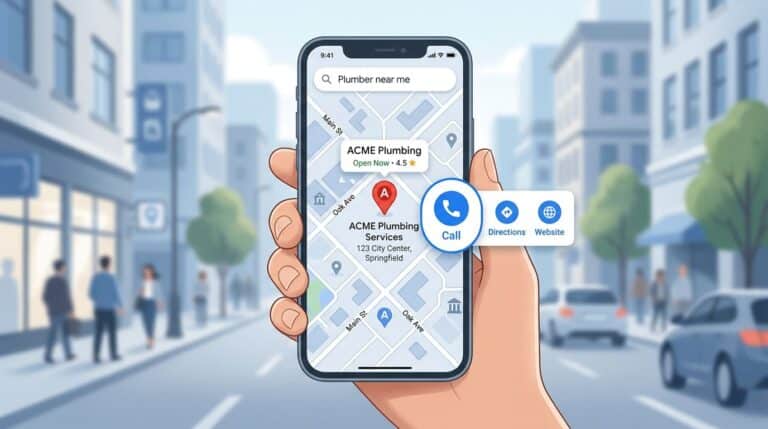
A customer stands on a sidewalk, phone in hand, and asks an AI tool for the best plumber, dentist, or roofer nearby. The answer doesn’t come from one page alone. It pulls from local pages, reviews, business listings, and trust signals scattered across the web.
That’s why the AI Search Visibility Audit Checklist works now. Search is no longer only a list of blue links. AI systems summarize the businesses they trust most, and trust starts with clear facts. If you want a wider view of that shift, Seoperform’s SEO to AEO transition guide is a useful starting point.
This checklist focuses on the pieces that shape local visibility first: location pages, Google Business Profile ties, NAP consistency, and proof that your business is real, active, and known in the area.
Start with the core details every local AI result needs to trust
Before you tweak page design or rewrite headlines, check the facts. Local visibility breaks down when your business details don’t line up. AI systems, maps, and search platforms look for agreement. If your name says one thing on your site and another on a listing, doubt creeps in.
Think of this as the foundation under a house. Fresh paint won’t help if the floor shifts.
Check your NAP everywhere your business appears
NAP means name, address, and phone number. It sounds simple. Still, small cracks show up all the time. A suite number disappears on one site. A call tracking number replaces the main line. Old addresses linger in forgotten directories.
Those tiny mismatches can weaken local trust because machines compare details across sources. A solid guide to NAP consistency shows how often “close enough” turns into confusion.
Keep the audit practical. Compare your website, Google Business Profile, Apple Maps, Yelp, Facebook, major data aggregators, industry directories, and local chamber listings. Use one spreadsheet. Log the source, the live NAP, the correct NAP, and who owns the fix.
A short review pass should cover:
- Business name as it appears on signage and legal-facing profiles
- Address format, including suite, unit, or floor details
- Primary phone number, not a mix of old and new lines
- Hours, especially holiday changes and lunch closures
- Landing page URL tied to each location
Fix the source first. Then update the downstream listings that copied the bad data.
If your business facts disagree across the web, AI tools hesitate before they recommend you.
Make sure your Google Business Profile matches your website
Your Google Business Profile should feel like a mirror of your local page, not a separate story. The business name, primary category, services, hours, address, and service area should line up. If your profile says “emergency HVAC repair” but your page looks like a generic home page, the tie feels weak.
Also, check the links. A location-specific profile should usually point to that location page, not always the homepage. That one choice helps both users and AI systems land on the most relevant source.
Photos, recent posts, Q&A, and review themes add context too. When those signals stay fresh, they help confirm that the location is active. For a deeper look at this link between listings and AI answers, see this guide on optimizing Google Business Profile for AI search.
Turn each location page into a strong local source
A location page should do one job well: prove that this business serves this place. That sounds obvious, yet many local sites still publish thin pages with swapped city names and little else. Those pages read like cardboard storefronts. People feel it, and machines do too.
Give every location page one clear job and one clear place
Each page should focus on a single office, city, or service area. Keep the copy unique. Use the exact business name, address, phone, hours, service details, and a clear call to action. If an embedded map helps a visitor confirm the location, include it.
The page should answer a real visitor’s quiet question: “Did I find the right place?”
That means the content can’t be vague. A thin city-swap template often repeats the same promise across ten pages with only the town name changed. It may exist for search engines, but it doesn’t help a person decide.
Good local pages feel grounded. They mention what’s offered there, who serves the area, and how to contact the right team. They also make the next step easy: call, book, get directions, or request an estimate.
Add local context that proves you belong in that area
This is where the page starts to breathe. Local details make a page feel lived in. Mention nearby landmarks, major roads, neighborhoods served, parking notes, transit hints, or building access tips if they matter. Add short area-specific FAQs. Include examples of work done in that market, as long as they’re real and useful.
You don’t need to stuff every suburb into a paragraph. One honest detail beats ten padded ones.
For example, a dental office page might mention parking behind the building, evening appointments on Thursdays, and service for nearby neighborhoods. A roofer might mention storm response times in a county they regularly cover. Those details help AI systems connect the page to a real place and real needs.
Use schema and page structure to remove guesswork
Clear page structure helps search systems read the same story you’re telling users. Use one strong H1. Keep contact details crawlable in the main content. Add location-specific title tags and meta descriptions that match the page topic. Then support the visible content with LocalBusiness schema, or a more specific subtype when it fits.
The key point is alignment. The schema should confirm what the page already says, not invent extra facts.
If the markup says one phone number and the page shows another, trust drops. The same goes for hours, address, and business type. For broader page quality ideas, Seoperform’s on-page SEO guide is a helpful companion to local page work.
Build the local proof signals that AI systems and customers both notice
Once the facts and pages are stable, proof becomes the next layer. People want signs that a business is active. AI systems look for that same pattern, repeated across public sources.
Reviews, testimonials, and real-world mentions matter more than ever
Not all reviews carry the same weight. A healthy review profile has volume, recency, and detail. It also shows that the business replies. When customers mention a city, service, or staff member, that creates extra local context.
On your site, add testimonials tied to real services and real locations. Short case studies help too, especially for high-trust fields like legal, medical, home services, and finance. Before-and-after examples can support that story when they’re honest and specific.
Public mentions matter as well. A local news feature, chamber member page, charity sponsor listing, or trade association profile all act like little votes of confidence. AI summaries often notice patterns, not one shining source. Repetition across trusted places is what builds the signal.
Photos, staff details, and community signals make the business feel real
Stock photos flatten trust. Original photos do the opposite. Show the storefront, office interior, trucks, job sites, team members, and work in progress. These details help visitors picture the business before they call.
Staff bios help too, especially when they mention role, years in the area, or local expertise. A short team section can quickly dispel doubt. So can a note about local memberships, school sponsorships, town events, or charity work.
None of this needs to sound grand. Simple proof works best because it feels true. A few candid photos and a real team page often say more than polished claims.
Run the audit on a schedule, then fix what will move visibility first
A local audit shouldn’t happen only after traffic drops. Make it recurring. Monthly works for active locations. Quarterly can work for smaller footprints, as long as someone owns it.
A broader local SEO audit framework can help shape that rhythm, but your version should stay simple enough to use.
Prioritize fixes by trust gaps, not by what is easiest
Start where doubt is highest. NAP conflicts come first because they affect every other signal. Next, fix the Google Business Profile links so that categories, URLs, hours, and services match the site. After that, strengthen weak location pages. Then build out proof signals like reviews, testimonials, and local mentions.
That order works because source-level trust problems spread outward. Fixing surface issues first is like mopping a floor while the pipe still leaks.
Track changes with a simple local visibility scorecard
You don’t need fancy software to track this. A small scorecard is enough.
| Signal | What to check | Status |
|---|---|---|
| Listing accuracy | NAP, hours, URLs, duplicates | Pass / Fix |
| Profile completeness | Categories, services, photos, posts, Q&A | Pass / Fix |
| Location page quality | Unique content, local details, CTA, schema | Pass / Fix |
| Proof signals | Review freshness, mentions, original photos | Pass / Fix |
Then watch the business outcomes, calls, direction requests, form leads, local rankings, and AI answer visibility, where you can observe it. The point isn’t a perfect score. The point is spotting drift before it becomes a bigger problem.
Local visibility grows when your facts match, your pages prove place, and your proof signals show a living business instead of a hollow shell. That’s the thread running through every strong local result.
Start with one location, not all of them. Tighten the details, fix the trust gaps, and turn that page into the version you’d want an AI system to quote back to a customer.